.png)


Invasives - the battle of land rights amongst flora
PART TWO: REMINDERS AND TECHNIQUES– WHO IS AT STAKE HERE?
In our last blog post, we reviewed the guidelines that are generally used to determine
whether or not an organism is considered an invasive species. Here they are, one more
time:
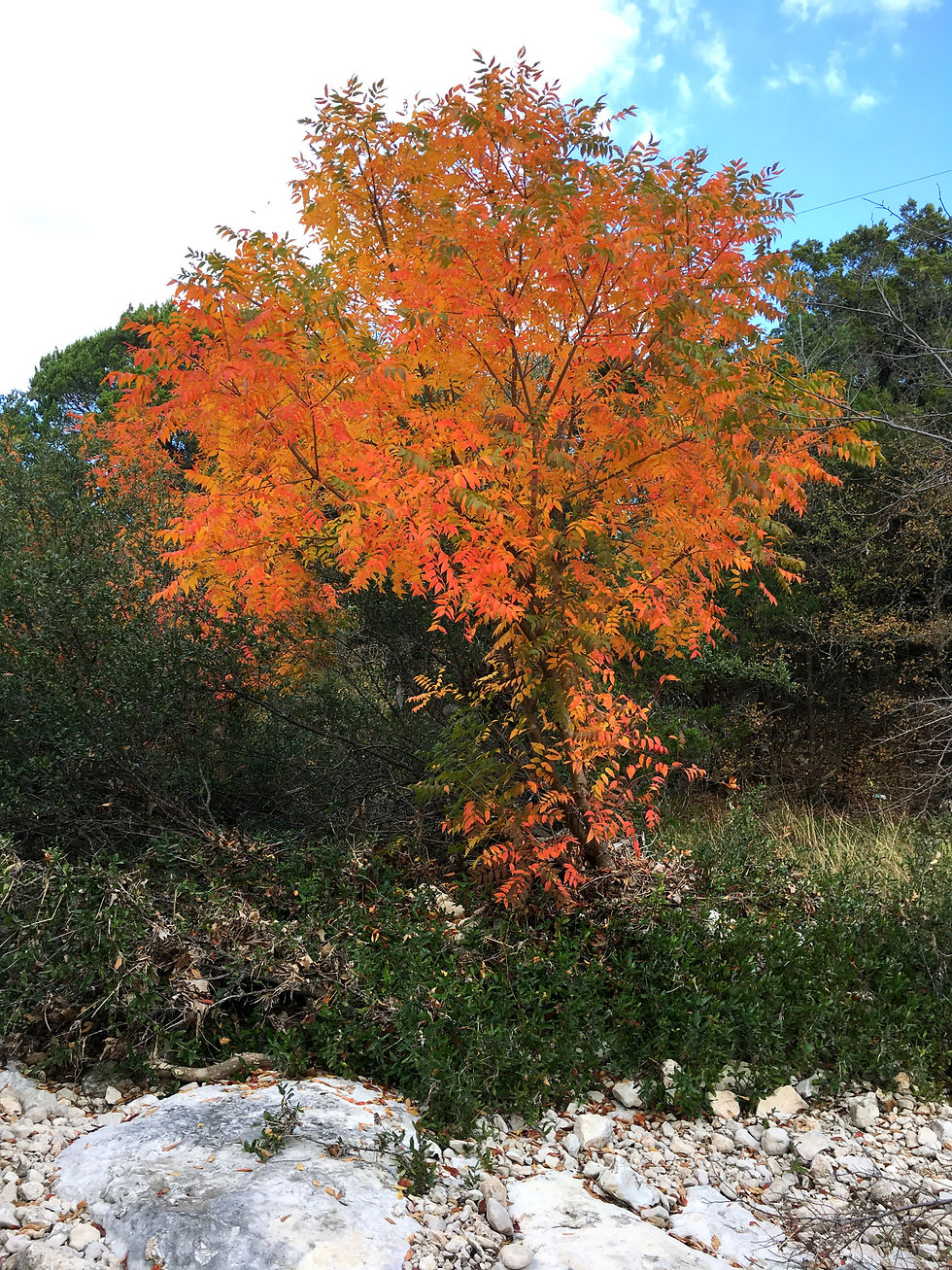
Liggustrum

1. The organism traveled to a new location with the help of humans or our tools
(intentional or not!)
2. The organism fundamentally changes its new environment to more suit its
needs, to the detriment of other organisms that live in the area. This completely alters
the ecosystem and typically reduces the overall biodiversity of the space.
3. A lack of relationships. The new organism has not formed reciprocal
relationships with other plants and animals within the ecosystem, and disrupts the
relationships that existed in the area prior to its arrival.
We also named three organisms that are invasive in Texas– Chinaberry Tree (Melia
azedarach), Vitex (Vitex agnus-castus), and Glossy-Leaf Privet (Ligustrum lucidum).
There are many other organisms that are considered to be invasive in Texas, but South
Austin Creek Alliance (SACA) focuses mainly on the removal of Ligustrum with a
technique called girdling.
SACA chooses to girdle invasive trees for a couple of reasons:
- Girdling is a fantastic opportunity for public education and direct engagement
with landscape management. We are a part of our ecosystems!
- Girdling helps keep our landscapes free of herbicides, which is especially
important in areas where water is present– healthy riparian areas are key for clean
water.
- Girdled trees continue to hold soil in place with their roots and provide
temporary shade to any young saplings under their canopies, protecting native species
and allowing replacement trees more time to mature before full exposure to the
elements.
- Girdling also creates standing deadwood, which is a critical resource for many
insects and birds.
- And, most of all– girdling is fun!
How do we decide where and when to girdle?
The most important part of this process is to be familiar with the land you want to
work on. Walk to and through the area frequently, during different seasons. Observe
who is there– what organisms are you sharing the space with? What animals and plants
will be impacted by girdling? How much of the canopy (tallest tree layer) is made up of
invasive trees, and how much of the understory (baby replacement trees) is composed
of invasive species? Is the area a monoculture? What other restoration activities might
benefit the area? Try to think about how the area changes over time, too.
Most urban creeks are heavily altered and disturbed by human activities. This
predisposes the land to be colonized by invasive species, which are typically organisms
that can survive extremes and possess extraordinarily high reproduction capabilities.
Native species can flourish in these areas, too– but they are still often outcompeted
when invasive species are introduced. Another reason why invasive plants are often
found in disturbed areas is that they are used in landscaping more often than native
species, so it's very easy for them to 'escape' into the woods. While this is beginning to
change, it's still extraordinarily common for developers to use invasive plants in their
projects.
Before committing to a girdling project, it's very important to make sure that
you've weighed the potential risks of additional disturbance to an area. The general rule
of thumb is that intervening to remove an invasive tree is usually a good idea, but there
are some situations where it might do more harm than good. Here are a couple
examples of things to watch out for:
Is the tree casting shade on water? If the tree died, will the sun hit the water and
heat it up? Keeping water cool is critical for organisms in hot places like Texas– if the
water temperature rises too much, most of the animals and plants living in it will die.
Is the tree the sole source of shade for a group of young native saplings? Are the
saplings large enough to survive without a nurse tree? (A good rule of thumb is that the
saplings should be at minimum waist height before exposure to full sun)
Is the invasive tree holding the bank / preventing erosion?
In cases like the above, it may be best to leave the invasive tree alone
temporarily and formulate a plan to address the tree without accidentally damaging the
ecosystem.
It's also a really good idea to prioritize girdling invasive trees that have
surrounded a mature native tree. This helps the native tree survive when times are
tough (like a drought is present) and allows the mature organism to continue
reproducing.
Another great place to prioritize is any place on the brink of becoming a
monoculture– i.e., all of the understory replacement trees are invasives while the
canopy is still predominantly native trees. If the invasive trees are removed, the native
overstory plants have a chance to reproduce.
REFRAMING A VIEW
Despite advocating for their removal, I believe the organisms that become
invasive are pretty extraordinary. They have found a way to survive and thrive in
situations where they are almost completely severed from the relationships they formed
with others as they evolved over millennia. Most organisms can't do this! We need
mutual relationships to survive: interdependency is the norm. Think about it– if you
removed a panda from the forest it evolved alongside and stuck it in the middle of the
Central Texas woods, the likelihood of that panda surviving and somehow reproducing
is extraordinarily small–much less becoming so successful that it completely alters the
Central Texas ecosystem!
And yet organisms are doing this every single day. If these plants and animals
weren't excluding other species from our ecosystems and dramatically altering our
landscapes, we would probably have a very different relationship to them. Kudzu, for
example, was originally introduced to the Americas with the intent that it be a resource
for people– it's a crop plant and provides wonderful, deep shade (a characteristic which
also contributes to its ability to completely alter the understory of a forest)– clearly, this
did not work (Blaustein, 2001).
But are there hidden opportunities here?
While we're doing habitat restoration and removing invasive species, is there a
way for us to benefit not only the ecosystem*, but ourselves directly? What I mean is
that funding for restoration activities is always shaky, but if we can demonstrate that a
project can boost the local economy by providing unique opportunities to the people
living there, a stable source of funds might be secured in addition to getting the public
directly engaged. Also, are there unique opportunities for research and learning that are
afforded by these species? Can we incorporate their harvest into industry or use them
to improve the soils where they had previously lived? What kinds of relationships do
these organisms have with others from their homelands? What niche are they filling
here? Why did they become invasive anyway– was the ecosystem in disrepair before?
It's also important to think about long-term management and expectations. How
can we shift our culture to incorporate better land management practices? How do we
convince developers to use native plants in their plantings instead? What do our long
term goals look like?
*Setting aside the fact that any benefits towards an ecosystem also benefit human
beings as we are a part of this Earth.
PART THREE: WHY GIRDLING WORKS
My favorite part of girdling is teaching people why this technique works, because
it means I get to gab about plant phytotomy (aka, anatomy).
The very basic idea is that plants are collections of tubes. Complicated, beautiful
bundles of tubes, capable of incredible feats– but tubes nonetheless.
Some of these tubes gather water from soil and transport it upwards through the
body of the plant (xylem). Other tubes bring down from the leaves delicious sugars–aka,
food–which were created via photosynthesis (phloem). The roots require these sugars
in order to live and continue to acquire water.
Different types of plants have different arrangements of their food and water
tubes (called vascular bundles). If you took cross sections of an oak tree trunk and a
palm tree trunk, and compared the arrangement of their xylem and their phloem tubes,
they would be completely different.
Monocot Vascular Bundle Arrangement (This is what the palm tree would look like,
approximately– the vascular bundles are the smaller, darker clusters of cells interspersed
throughout the stem). Photo courtesy of libretexts. https://bio.libretexts.org/Bookshelves/Botany/
Plant_Anatomy_and_Physiology_(Bellairs)/03%3A_Stem_Leaf_and_Root_Anatomy/3.01%3A_Stems
Dicot Cross Section of Vascular Bundle Arrangement (this is what the Oak tree would look like,
approximately). Photo courtesy of libretexts. https://bio.libretexts.org/Courses/Coalinga_College/
Introduction_to_Plant_Science_(Hochman_Adler)/09%3A_Tissues_and_Organs_-_How_the_Plant_is_Built/9.04%3A_The_Stem/
9.4.01%3A_Inside_Stems
Note that monocots like the palm "tree" have their water and food tubes scattered all
throughout the cross section of the trunk, whereas the dicot's vascular bundles are
arranged in a ring around the edges of the stem, right under the bark. The location of
sugar-laden vessels under the bark (also called cork) in many dicots allows humans to
access them, harvest their contents (yum! Maple syrup!)– or, in the case of an unlucky
few– kill the organism entire.
Girdling works by severing the sugar carrying tubes and preventing the tree from
feeding itself. It's simple: remove a strip of bark and the phloem layer beneath it, all the
way around a trunk, and that trunk will cease transporting food to the roots below. Do
this to all of the trunks on a tree, and it will die– slowly, by inches. It can take up to two
years for a girdled tree to starve, though most succumb in a year or less, so long as the
bark doesn't reconnect itself.
And on that dark note– thank you for reading! We hope that you join SACA for our next
restoration event. Keep your eyes on September and October!
Resources:
https://www.srs.fs.usda.gov/pubs/ja/ja_blaustein001.pdf (Blaustein, Richard J. 2001)
Please note that this article, like many others about invasive species, uses pretty loaded
language and is strongly biased– keep this in mind if you check it out.
Introduction to Botany:
Introduction_to_Plant_Science_(Hochman_Adler)
Beginner Friendly Books about plants (available through the Austin Public Library):
The Nature of Plants: An introduction into how plants work by Craig Norman Huegel
The Light Eaters by Zoë Schlanger– synopsis / collection of most recent research into
plant behavior, learning, and similar.

Comments